Sports guide
Pool Game Tips: 12 Timed Games, One Clear Winner
Key takeaways
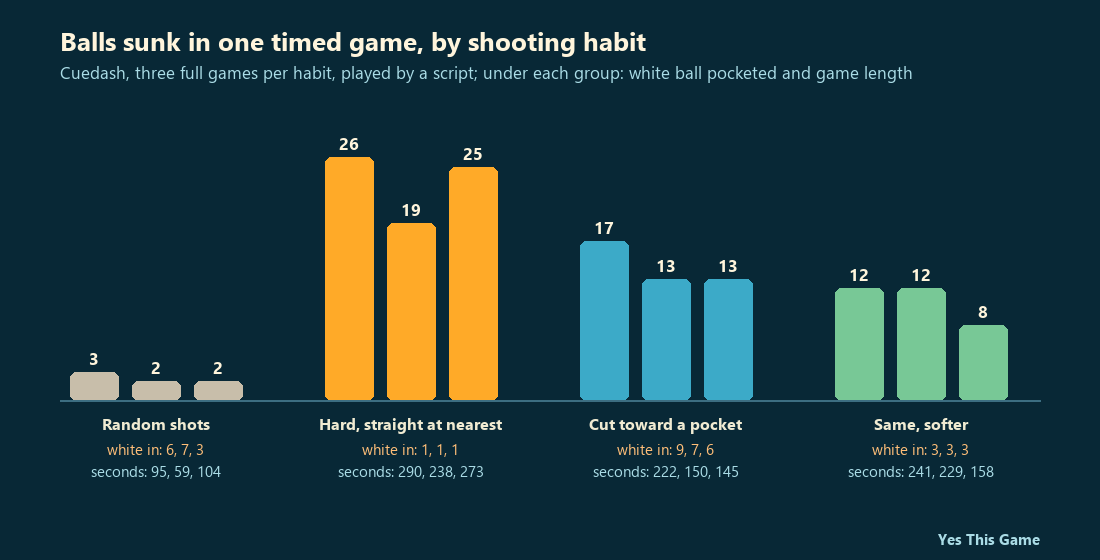
- Hard, straight shots at the nearest ball sank 19, 25 and 26 balls and lasted 238 to 290 seconds.
- That habit put the white ball in a pocket only once per game.
- Cutting balls toward pockets sank 13 to 17, but the white ball followed 6 to 9 times, at 10 seconds each.
- Random shots sank 2 or 3 balls and the clock ran out in 59 to 104 seconds.
The first pool game tip is to hit the ball you aim at full and firm: in Cuedash, hard straight shots at the nearest ball sank 19 to 26 balls per timed game and put the white ball in a pocket only once each game. Cutting balls toward pockets looked smarter but sank fewer, because the white ball kept following them in.
How Cuedash works
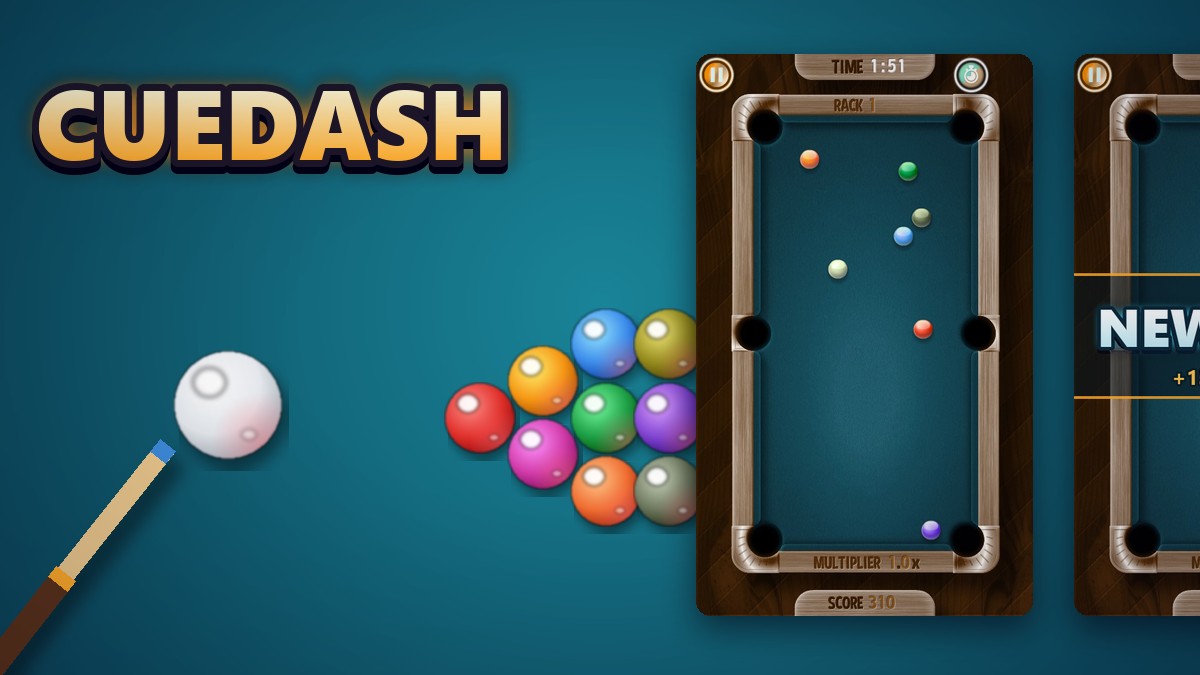
Cuedash is speed pool against the clock. Nine coloured balls sit on a blue-green table and you shoot by pressing on the white ball, pulling back and letting go. The clock starts at two minutes. Every ball you sink adds 5 seconds, a cleared rack adds 15, and the white ball in a pocket takes 10 away. Each ball is worth ten times the multiplier, which starts at x10, rises by one with every pot and drops back after any shot that sinks nothing. The game ends when the clock reaches zero, so the question is simple: which way of shooting keeps the clock alive longest?
What we measured
We played 12 full games in a test browser at the game’s own portrait size. A script pressed on the white ball, dragged back and let go, the same way a player does with a mouse or a finger, and read the game’s own counters until the “Time’s up” screen. It tried four habits, three games each: random direction and strength; a hard, straight shot at the nearest ball with no thought about pockets; a cut shot aimed so the object ball should travel to the easiest pocket, at medium to firm strength; and the same cut shot played softer. The script is not a person, so the numbers show what each habit does, not what a skilled player can reach.
| Habit | Balls sunk | White ball in | Game length (seconds) | Best score |
|---|---|---|---|---|
| Random shots | 3, 2, 2 | 6, 7, 3 | 95, 59, 104 | 310 |
| Hard, straight at the nearest ball | 26, 19, 25 | 1, 1, 1 | 290, 238, 273 | 2780 |
| Cut toward a pocket | 17, 13, 13 | 9, 7, 6 | 222, 150, 145 | 1750 |
| Cut toward a pocket, softer | 12, 12, 8 | 3, 3, 3 | 241, 229, 158 | 1220 |
12 games in one test browser, all shots made by a script, not by people. The racks are set the same way each time, but the balls scatter differently from game to game. The script never used the stopwatch that turns the clock off and did not aim for the clock tokens.
Full, firm hits won
The plainest habit did best. Shooting hard and straight at the nearest ball sank 19, 25 and 26 balls, cleared two full racks in every game and kept the clock running for four to five minutes. It also had the best pot rate, around 4 balls for every 10 shots. The table is small and the pockets are big, so a firm hit sends balls into the rails and the pockets often enough to pay for the misses.
The scratch is the real enemy
The cut shots sank a fair number of balls, 13 to 17 per game, but they lost the white ball 6 to 9 times a game. At 10 seconds each, that is one to one and a half minutes thrown away, plus a multiplier reset every time. The reason is basic pool physics. When the white ball hits another ball full on, it hands over most of its speed and stops close to where it hit. On a thin cut it keeps much of its speed and rolls on, and on a table this size it often rolled into a pocket. The straight shots lost the white ball just once a game.
Softer cuts: safer, but slower
Playing the same cuts more softly brought the scratches down to 3 per game, but the pots dropped too, to 8 to 12. With fewer penalties the games even lasted a little longer, 158 to 241 seconds, yet the scores were lower. In a game where every pot buys 5 seconds, a shot that does not reach the pocket is a slow way to lose.
Random shots run out fast
Random direction and strength sank only 2 or 3 balls per game. With 3 to 7 scratches on top, the clock ran out in 59 to 104 seconds, before the starting two minutes were even used up.
5 tips that follow from the numbers
- Hit the object ball full. Straight shots kept the white ball on the table and sank the most.
- Shoot firmly. Soft shots were safer but sank about a quarter fewer balls.
- Treat thin cuts as risky. They cost the white ball up to 9 times a game in our test.
- Keep potting in a row. Each ball raises the multiplier by one, and any shot that sinks nothing resets it.
- Use the stopwatch to practise. The button in the top right turns the clock off while you learn the angles.
Where to try it
Try it yourself in Cuedash. For another drag and release game, Discstrike is finger soccer with flicked discs, and Pinroll is a ten-frame bowling game.
Frequently asked questions
How long is a game of Cuedash?
The clock starts at two minutes. Each pot adds 5 seconds, each cleared rack 15, and the white ball in a pocket takes 10 away, so our games lasted from 59 to 290 seconds.
What is a scratch in pool?
Sinking the white ball. In Cuedash it costs 10 seconds and sends the multiplier back to x10.
Why did straight shots scratch less?
When the white ball hits another ball full on, it gives away most of its speed and stops near the contact point. On a thin cut it keeps rolling, and in our games it often rolled into a pocket.
Do soft shots help?
They cut the scratches from 6 to 9 per game down to 3, but they also sank fewer balls: 8 to 12 instead of 13 to 17.
How does the multiplier work?
Each ball scores ten times the multiplier. It starts at x10, rises by one with each ball and drops back after a shot that sinks nothing.
Is this how people play?
No. A script played every game, dragging from the white ball like a player would. The numbers show what each habit does, not what a skilled player can reach.