Arcade guide
Lane Switch Game Tips: 28 Orbgate Runs, Shape First
Key takeaways
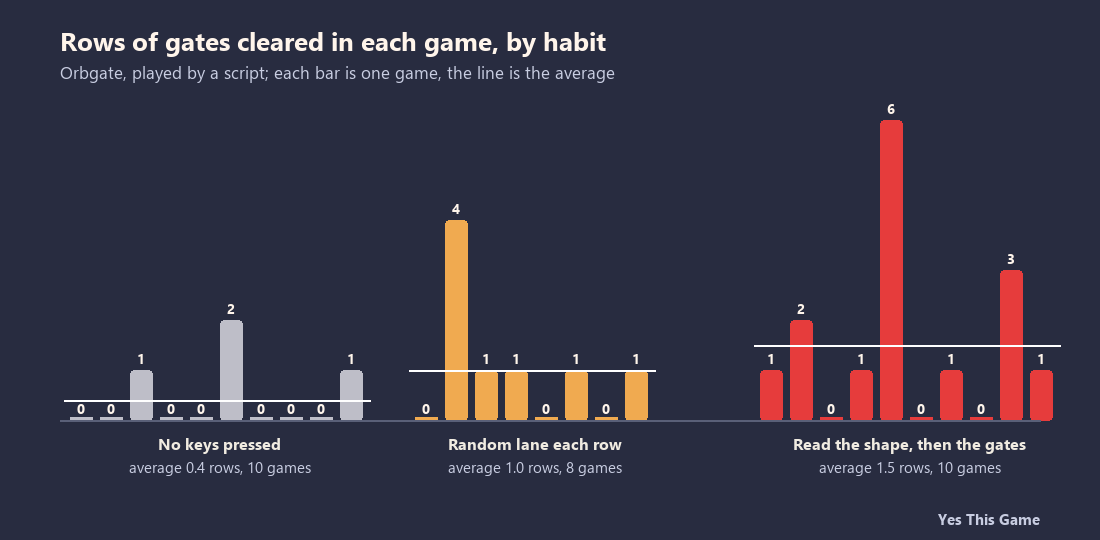
- With no keys pressed, 7 of 10 runs ended at the first row of gates; the average was 0.4 rows.
- Picking a random lane each row averaged 1.0 rows over 8 runs.
- Reading the shape first, then the gates, averaged 1.5 rows and reached 6 once.
- A new row arrives about every 2 seconds, so the decision window is short.
The first lane switch game tip is to check your own shape before you look for the gate: in Orbgate the shape changes between rows, and a script that read it first averaged 1.5 rows per run with a best of 6, against 0.4 for a run with no keys pressed. The rows also come quickly, about one every 2 seconds, so the decision has to be early.
How Orbgate works
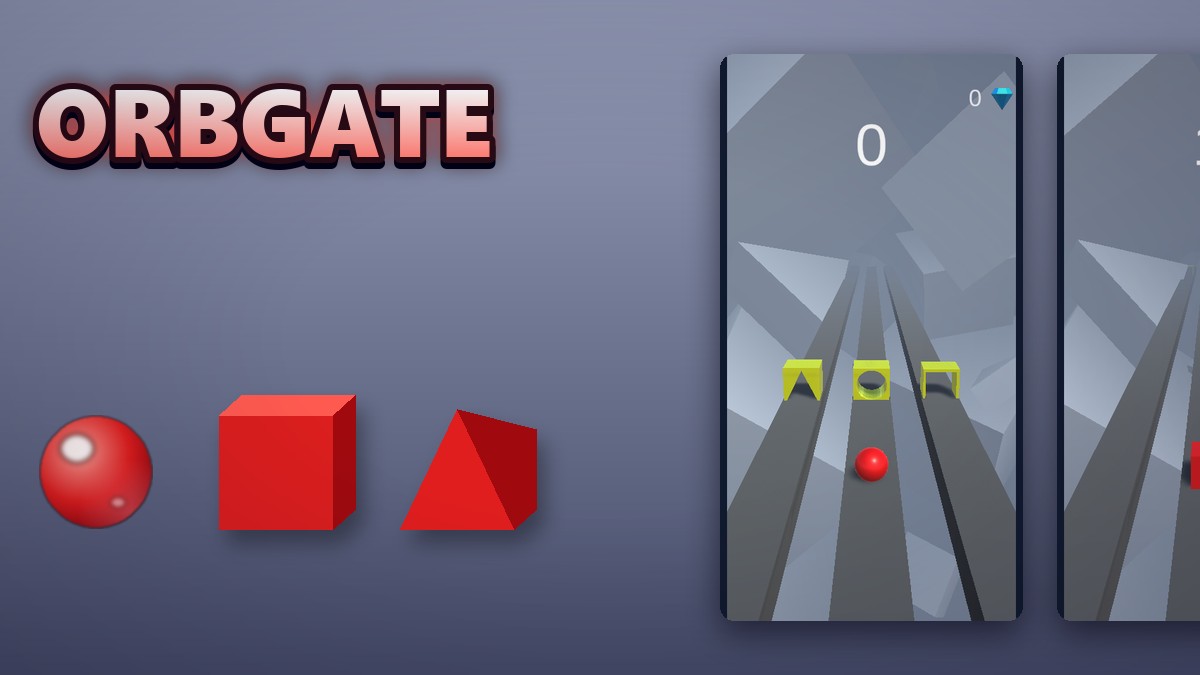
Orbgate is a lane switch reflex game. A red shape rolls along a three-lane road toward rows of yellow gates, and each row holds one gate with a round hole, one with a triangle and one with a square arch, in a different order every time. Between rows the shape changes: a ball can turn into a cube or a triangular prism. The left and right arrow keys move one lane per press, and only the gate that fits the current shape lets it through. Each cleared row is one point.
What we measured
We played the game in a test browser with software rendering. A script took screenshots of the road about six times a second, pressed the arrow keys and counted the rows cleared before the run ended. It tried three habits, ten runs each: pressing nothing, so the shape stayed in the middle lane; moving to a random lane for each row; and reading the shape near the bottom of the screen, finding the gate with the matching opening and moving there. In two of the random runs the script did not notice the end of the run, so we left those two out. That leaves 28 runs. The script is not a person, so the numbers show what each habit does, not what a skilled player can reach.
| Habit | Runs | Rows cleared per run | Average | Best |
|---|---|---|---|---|
| No keys pressed | 10 | 0, 0, 1, 0, 0, 2, 0, 0, 0, 1 | 0.4 | 2 |
| Random lane each row | 8 | 0, 4, 1, 1, 0, 1, 0, 1 | 1.0 | 4 |
| Read the shape, then the gates | 10 | 1, 2, 0, 1, 6, 0, 1, 0, 3, 1 | 1.5 | 6 |
28 runs in one test browser, all key presses made by a script, not by people. The script saw the road about six times a second, which is slower than a person’s eyes, and it sometimes misread small, distant gates.
The shape changes, so check it first
Our first version of the script assumed the shape was always a ball and went for the round hole every time. It kept failing at the second or third row, and the screenshots showed why: after a cleared row the ball had turned into a cube or a prism. Once the script read the shape before choosing a gate, it cleared up to 6 rows in a run. For a player the lesson is the same: glance down at your own shape, then up at the row.
About two seconds per row
The first row reached the shape about 1.9 seconds after play, and every next row about 2.1 seconds later: one row took 3.9 to 4.2 seconds in total, two rows 6.2 to 6.3, three rows 8.2 to 8.4, and the six-row run lasted 14.2 seconds. The gates are small when they appear, so most of those two seconds are spent waiting for them to become readable. Move as soon as you can tell the openings apart, because the lane change itself takes a moment.
Staying put is a one-in-three bet
With no keys pressed the shape stays in the middle lane, so each row is a one-in-three chance. That is what we saw: 7 of 10 runs ended at the first row, and the best cleared 2. Random lanes did a bit better on average, mostly thanks to one lucky run of 4.
4 tips that follow from the numbers
- Shape first, gates second. The right lane depends on what you are this row.
- Decide in the first second. Rows arrive about every 2 seconds.
- Count your presses. Going from one side to the other takes two presses, so start early.
- Never just wait in the middle. It only works one row in three.
Where to try it
Try it yourself in Orbgate. For another quick matching game, Prismhop sends a ball through colour bars, and Laneweave has you weave between lanes of traffic.
Frequently asked questions
What is the goal in Orbgate?
Move your shape into the lane whose gate opening fits it: round for a ball, square for a cube, triangle for a prism. Each cleared row is one point.
Does the shape stay the same?
No. It changes between rows, for example from a ball to a cube, so the right lane changes too.
How fast do the rows come?
In our runs the first row arrived about 1.9 seconds after play and the next ones about every 2.1 seconds.
Can you win by staying in the middle?
Only by luck. With no keys pressed, 7 of 10 runs ended at the first row and the best run cleared 2.
Does a random lane help?
A little. Random lanes averaged 1.0 rows over 8 runs, against 0.4 with no keys.
Is this how people play?
No. A script read the screen about six times a second and pressed the arrow keys. A person who looks ahead can react faster and score more.