Arcade guide
Bouncing Ball Game Tips: 30 Padleap Runs, 0.6 s a Pad
Key takeaways
- A new pad reaches the ball about every 0.6 seconds.
- With one press and no steering, runs landed 0 to 2 pads, 0.6 on average.
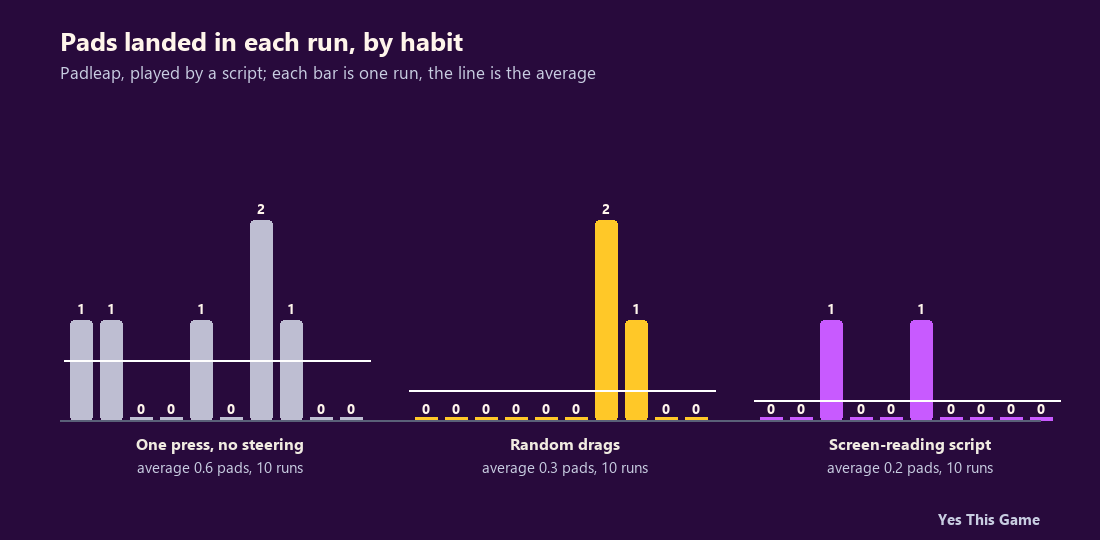
- Random drags averaged 0.3 pads and a script that read the screen six times a second averaged 0.2.
- No script came close to a person: the rhythm is faster than six looks a second can follow.
The first bouncing ball game tip is to steer by rhythm, not by checking every frame: in Padleap a new pad reaches the ball about every 0.6 seconds, and none of our three scripted habits landed more than 2 pads in a run. Even a script that read the screen six times a second averaged only 0.2 pads, which tells you how little time each landing gives you.
How Padleap works
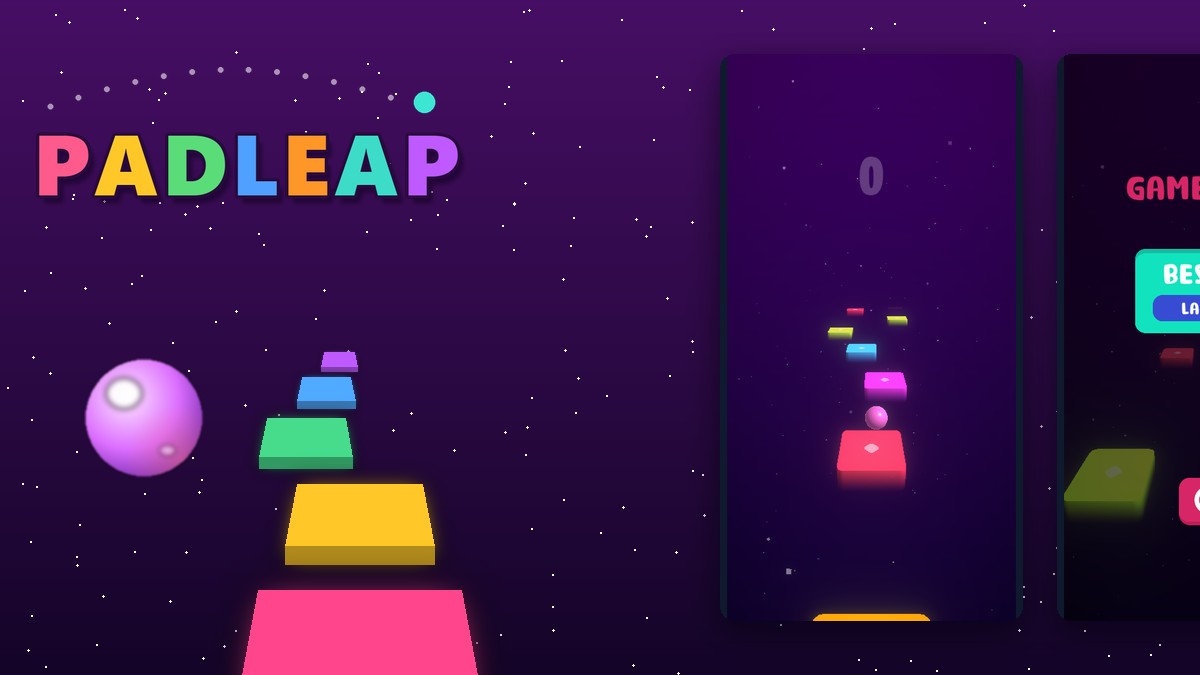
Padleap is a bouncing ball game set in deep space. A glossy ball hops from pad to pad by itself while glowing pads keep arriving from the distance, sometimes straight ahead and sometimes off to the left or right. You press on the game and drag sideways to move the ball; it keeps hopping no matter what. Every pad it lands on is a point, and a single miss drops it into the dark and ends the run. The game over card shows your last score next to your record.
What we measured
We played Padleap in a test browser with software rendering and read each score from the LAST line on the game over card. A script tried three habits, ten runs each: one press to start and then no steering at all; random drags left and right; and a screen-reading script that took about six screenshots a second, found the next pad and the ball, and dragged toward the pad. We also timed each run from the first drag to the game over card. The scripts are not people, so the numbers show what each habit does, not what a skilled player can reach.
| Habit | Runs | Pads landed per run | Average | Best |
|---|---|---|---|---|
| One press, no steering | 10 | 1, 1, 0, 0, 1, 0, 2, 1, 0, 0 | 0.6 | 2 |
| Random drags | 10 | 0, 0, 0, 0, 0, 0, 2, 1, 0, 0 | 0.3 | 2 |
| Screen-reading script | 10 | 0, 0, 1, 0, 0, 1, 0, 0, 0, 0 | 0.2 | 1 |
30 runs in one test browser, all input from scripts, not from people. The screen-reading script saw the game about six times a second, which turned out to be too slow for this game.
About 0.6 seconds per pad
Runs that missed the very first pad ended about 0.9 to 1.1 seconds after the first drag, runs with one pad after 1.5 to 1.6 seconds and the two-pad runs after 2.2 seconds. That is roughly 0.6 seconds for every pad. At six looks a second the screen-reading script saw each pad only three or four times before it had to be under the ball, and its drags arrived too late. A person who keeps watching the next pad and moves smoothly has a big advantage over that.
Holding still beats flailing
With no steering at all, the ball lands on whatever lies straight ahead, so a run lasts until the first pad that sits to the side: 0, 1 or 2 pads in our ten runs, 0.6 on average. Random drags did worse, 0.3 on average, because they pushed the ball off pads it would have hit by doing nothing.
4 tips that follow from the numbers
- Plan in the air. With 0.6 seconds per pad, choose the next drag while the ball is still rising.
- Small, smooth drags. Random jerks landed half as many pads as no steering at all.
- Leave straight pads alone. If the next pad is ahead, do not move.
- Watch the next pad, not the ball. The ball goes where you drag; the pad decides where that should be.
Where to try it
Try it yourself in Padleap. For another quick reflex game, Orbgate sends a changing shape through matching gates, and Prismhop bounces a ball through colour bars.
Frequently asked questions
How do you steer in Padleap?
Press on the game and drag sideways. The ball follows your drag and keeps hopping forward by itself.
How fast is the game?
In our runs a new pad arrived about every 0.6 seconds: a run that missed the first pad ended about 1 second after the first drag, a two-pad run after about 2.2.
Does doing nothing work?
Only for a pad or two. With no steering our ten runs landed 0, 1 or 2 pads.
Do random drags help?
No. Ten runs of random drags averaged 0.3 pads, below the 0.6 of no steering.
Why did the screen-reading script fail?
It could only look about six times a second, which is less than four looks per pad, and every drag lands a moment after it is made. It averaged 0.2 pads.
Is this how people play?
No. These were scripts. A person who watches the next pad and drags smoothly can land far more.