Arcade guide
Ball Rolling Game Tips: 36 Pier Runs, Three Habits
Key takeaways
- Holding only the up key finished the straight first pier in about 3 seconds but fell into the sea on most of the others.
- Steering through the shells at full speed earned 8 stars in each of two runs, the most of any habit.
- A speed cap made the same route slower: 17.4 to 17.8 seconds on pier 3 instead of 15.5 to 15.7.
- Piers 4 and 5, with trampolines and gaps, beat every script, and pier 2's rope railings trapped the shell route.
The first ball rolling game tip is to steer along the boards and then commit to speed: in Quillpier, a script that steered through the shells at full speed earned 8 stars across the six piers in each of two runs, while one that only held the up key earned 2 and 4. A speed cap did not help either: it was slower and lost a time star.
How Quillpier works
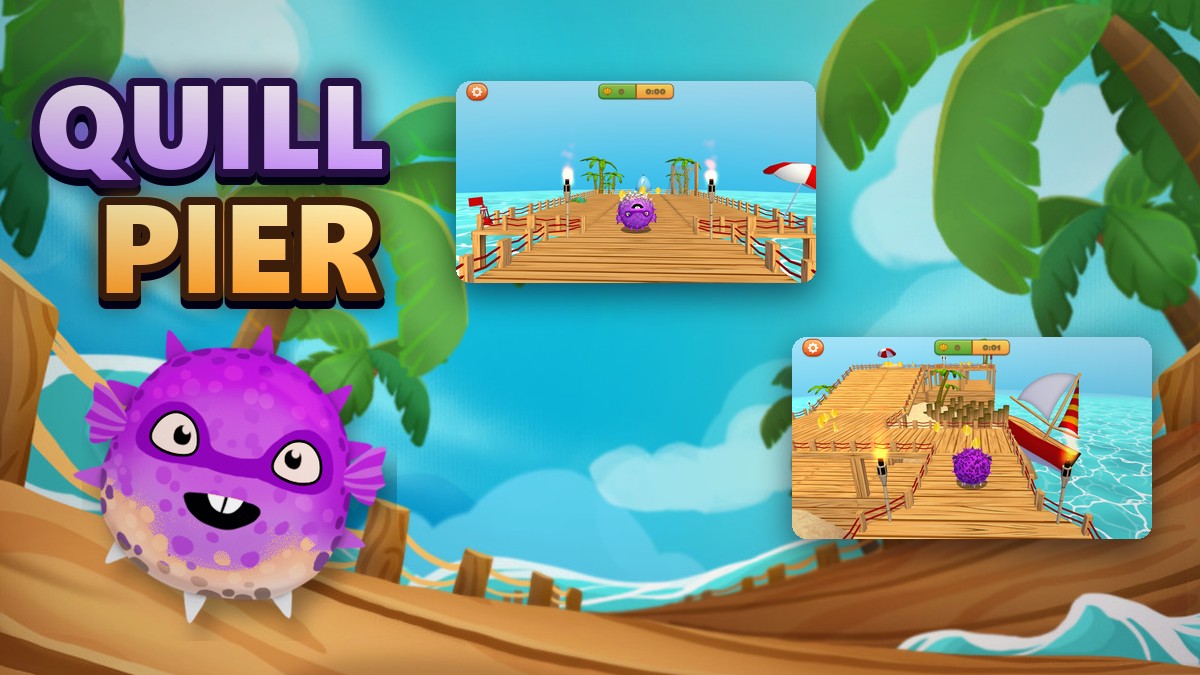
Quillpier is a 3D rolling game. You steer a spiky violet puffer fish along wooden piers over the sea, with the arrow keys on a computer or an on-screen joystick on a phone. The fish keeps its speed, so you have to brake before turns. Golden shells lie along the boards and a friend waits at the end of each pier. Fall into the sea and the pier restarts with the clock and shells reset. Each of the six piers gives up to three stars: one for reaching the end, one for collecting every shell and one for finishing inside the star time, which is 5, 10, 18, 6, 10 and 10 seconds for piers 1 to 6.
What we measured
We played every pier in a test browser at 1280 by 720 pixels with software rendering. A script pressed the real arrow keys and read the game’s own clock, shell count and stars. It tried three habits, two runs each, with up to 60 seconds or six falls per pier: holding only the up key; steering through the shells in nearest-first order and then to the finish, at full speed; and the same route with a speed cap of less than half. That makes 36 pier attempts. The script is not a person, so the numbers show what each habit does, not what a skilled player can reach.
| Pier | Hold forward only | Steer for shells, fast | Steer for shells, speed cap |
|---|---|---|---|
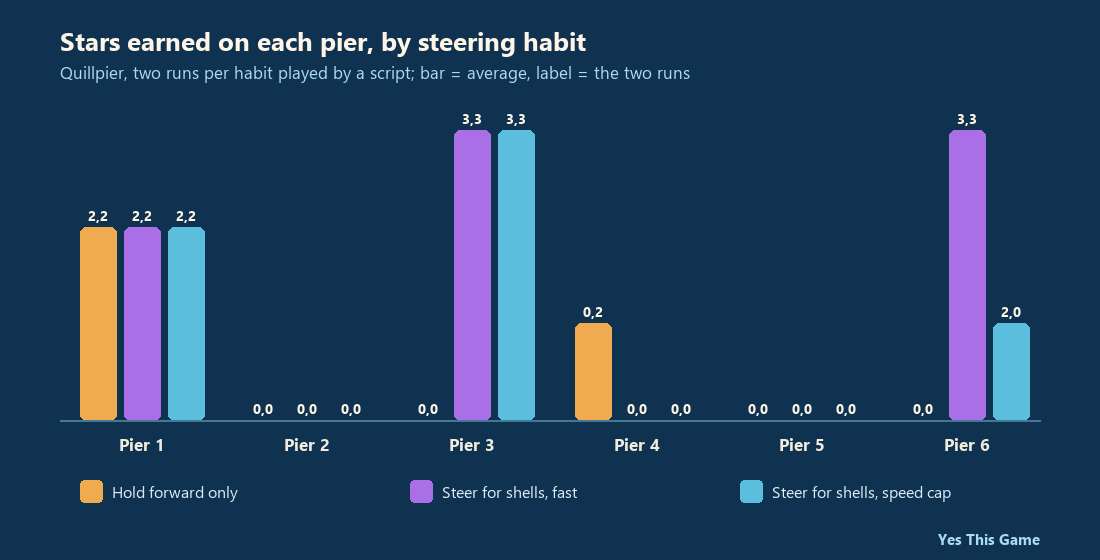
| 1 (star time 5 s) | finished in 2.95 and 2.98 s, 3 of 5 shells, 2 stars | 5.97 s twice, 5 of 5, 2 stars | 5.95 and 6.05 s, 5 of 5, 2 stars |
| 2 (10 s) | 6 falls in each run | stuck at a railing, 0 of 9 | stuck at a railing, 0 of 9 |
| 3 (18 s) | 5 falls, no shells | 15.54 and 15.67 s, 21 of 21, 3 stars | 17.36 and 17.79 s, 21 of 21, 3 stars |
| 4 (6 s) | finished once in 2.68 s after 4 falls, 2 stars; 6 falls in the other run | 3 falls each run | 3 falls each run |
| 5 (10 s) | 6 falls, or stuck | 4 falls each run | 3 falls each run |
| 6 (10 s) | 6 falls each run | 9.13 and 9.16 s, 9 of 9, 3 stars | 11.48 s and 2 stars; 2 falls in the other run |
| Total stars | 2 and 4 | 8 and 8 | 7 and 5 |
36 pier attempts in one test browser, all key presses made by a script, not by people. The script chose shells nearest-first and did not plan around railings or trampolines. Each habit ran on its own so that they all had the same computer speed.
Holding forward works once
Pier 1 is a straight walkway, and holding the up key finished it in under 3 seconds, well inside the 5-second star time. It also rolled past two of the five shells. On every pier with a turn the same habit went into the sea, five or six times per run, and the only other finish came on pier 4 after four falls. Speed without steering ends in the water.
Fast and steered won
Steering through the shells at full speed collected all 21 shells on pier 3 and all 9 on pier 6, and beat the star time on both for three stars each, in both runs. On pier 1 it collected all five shells but needed about 6 seconds, one second over the star time. Zigzagging between shells costs time, so pier 1’s third star needs a tighter line through them.
A speed cap only cost time
The capped route took 17.4 to 17.8 seconds on pier 3 instead of 15.5 to 15.7, still inside 18 seconds. On pier 6 it took 11.48 seconds against a 10-second star time and lost that star, and in the other run it fell twice. Going slower did not save it from the sea on piers 4 and 5 either: three falls each run, the same as at full speed.
Where every script failed
Pier 2 has rope railings and walkways side by side. The nearest shell was on a walkway across the rail, so both steering scripts pushed against the rope for the whole minute without collecting anything. Piers 4 and 5 add trampolines and gaps in the boards, and no habit finished pier 5 at all. These are the piers where a person who looks ahead beats a script that only aims at the next shell.
5 tips that follow from the numbers
- Steer from the first second. Holding forward finished only the straight pier.
- Go fast where the rails protect you. Full speed earned three stars on piers 3 and 6.
- Follow the boards, not the shortest line. The nearest shell may sit behind a railing.
- Take pier 1 in two tries. One run for the shells, one straight run for the time, or a very tight line for both.
- Slow down only before trampolines and gaps. A general speed cap cost time and still fell in.
Where to try it
Try it yourself in Quillpier. For another rolling game, Gleamroll steers a ball along a road above the clouds, and Coilkeys drops a ball down a turning tower.
Frequently asked questions
How many piers does Quillpier have?
Six. Each awards up to three stars: one for finishing, one for every shell and one for beating the star time, which ranges from 5 to 18 seconds.
Does holding forward work?
Only on the straight first pier, where it finished in about 3 seconds while missing two of the five shells. On the other piers our script fell into the sea again and again.
Is it better to go slow?
Not on fenced piers. With a speed cap our script was about 2 seconds slower on piers 3 and 6 and lost the time star on pier 6.
Why did the script get stuck on pier 2?
It aimed straight at the nearest shell, which sat on another walkway, and pushed against the rope railing. Follow the boards, not the shortest line.
What happens when you fall in?
The pier restarts from the beginning, and the clock and shells are reset.
Is this how people play?
No. A script pressed the arrow keys. The numbers show what each habit does, not what a skilled player can reach.