Stacking guide
Stacking Game Tips: Twenty Test Runs in Slabspire

Key takeaways
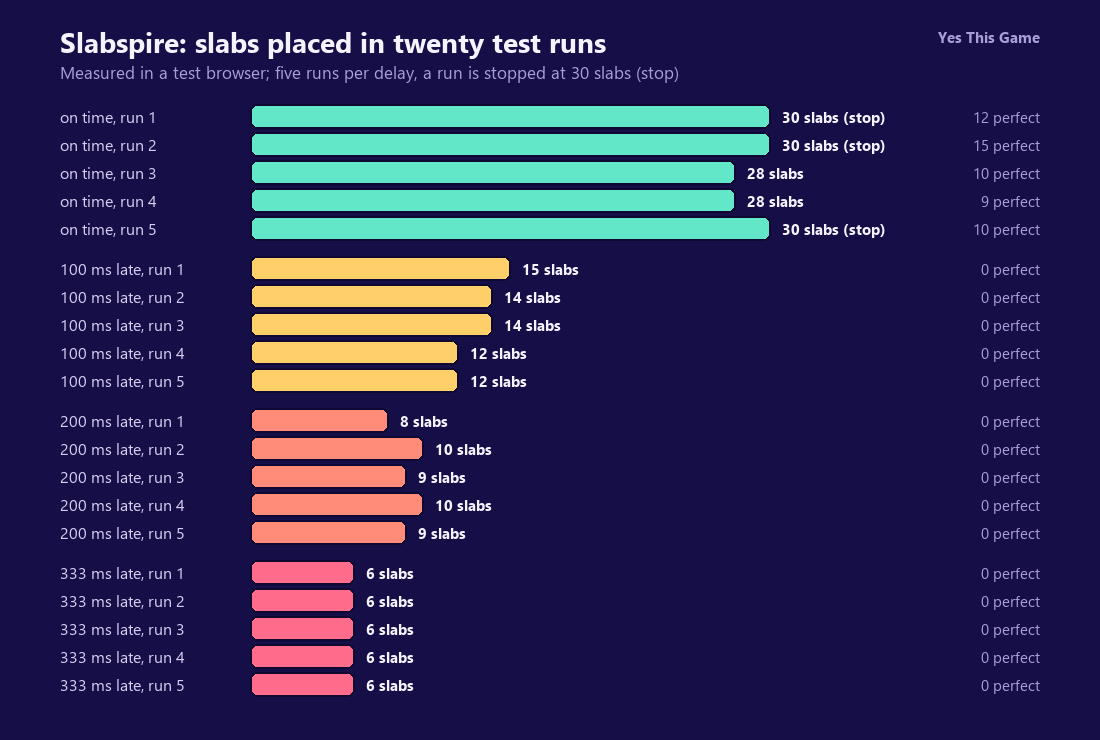
- A test bot that dropped each slab within about 50 ms of the crossing placed 28 to 30 slabs per run; the same bot 100 ms late placed 12 to 15.
- Not one of the 15 runs with a 100, 200 or 333 ms delay produced a single perfect drop; the 5 on-time runs made 9 to 15.
- A pass over the tower takes 3.7 seconds for the first drop and 1.6 seconds for the 29th.
- Across 286 measured drops the width lost always equalled the overhang, and every drop closer than 0.3 units kept its full width.
The first stacking game tip for Slabspire is to drop the slab at the instant it crosses the tower: our test bot did it within about 50 ms and placed 28 to 30 slabs per run, while the same bot 100 ms late never made a perfect drop and stopped at 12 to 15. We played twenty runs in a test browser and wrote down what the game did, so the numbers below come from the game itself.
How the game works
A slab starts at one side of the tower and slides across it. You drop it with a click, a tap or the Space key. What overhangs is cut off and falls; what sits on the tower stays and becomes the base for the next slab, which is exactly as wide. A drop within 0.3 units of the slab below snaps on and keeps its full width. The first slab is 10 units wide. The run ends when a slab misses the tower completely, and your score is the number of slabs placed.
What we measured
A script played the real page at 1280 by 800 pixels. The page publishes the position of the sliding slab and of the slab below it, and the script dropped each slab when it crossed the tower plus a fixed delay, with a random jitter of up to 50 milliseconds either way (three game steps at 60 steps per second). The script looked at the page once per drawn frame, which in our software-rendered test browser is only a few tens of times per second, so even the on-time runs carry a timing error of a few hundredths of a second. Four delays, five runs each; a run was stopped at 30 slabs.
| Delay | Runs | Slabs placed | Perfect drops | Outcome |
|---|---|---|---|---|
| On time | 5 | 28 to 30 (median 30) | 9 to 15 | 3 of 5 reached the 30-slab stop |
| 100 ms late | 5 | 12 to 15 (median 14) | 0 to 0 | all missed the tower |
| 200 ms late | 5 | 8 to 10 (median 9) | 0 to 0 | all missed the tower |
| 333 ms late | 5 | 6 to 6 (median 6) | 0 to 0 | all missed the tower |
One test browser, five runs per delay, so treat the numbers as a small sample. The bot is not a skilled player: it knows the position but not how to plan. A delay of 100 milliseconds is about the length of a quick blink.
How fast the slabs slide
We held back the drop on chosen slabs and timed two full passes over the tower. A drop number is the count of slabs you have dropped, so drop 1 is the first slab you release. Speed is given per game step and per second; the last column is how long a perfect drop stays possible, because the window is 0.3 units on each side of the target.
| Slab | Units per step | Units per second | Seconds per pass | Perfect window (ms) |
|---|---|---|---|---|
| Drop 1 | 0.11 | 6.6 | 3.67 | 91 |
| Drop 9 | 0.15 | 9 | 2.69 | 67 |
| Drop 19 | 0.20 | 12 | 2.02 | 50 |
| Drop 29 | 0.25 | 15 | 1.63 | 40 |
The window column is calculated from the measured speed (0.6 units divided by the units per second). Beyond the 29th drop the pace keeps rising, but we did not time those passes.
What a cut costs
We compared 286 drops from these runs with the rule. Every drop closer than 0.3 units (56 of them) kept its full width, and for each of the other 230 the width that remained was the old width minus the offset, to within a thousandth of a unit. The largest offset that still landed on the tower was 3.47 units. A cut is permanent: the tower only gets narrower, so the on-time runs ended with the last slab between 0.5 and 5.1 units wide.
4 tips that follow from the numbers
- Time the crossing, not the edge. The on-time bot placed slab 28 to 30 in every run; at 100 ms late it never got past slab 15.
- Tighten up as you climb. The same 100 ms of lateness is 0.66 units on the first drop but 1.5 units on the 29th, because the slab is moving more than twice as fast.
- Treat every cut as permanent. A small offset early is cheap, but the width you lose never comes back.
- Use the dashed line. It marks the height of your highest tower, so you know when a run turns into a record.
Where to try it
Try it yourself in Slabspire. For another quick game of timing, Ionwing is a neon space shooter, and Pathloom is a glowing maze game.
Frequently asked questions
How do I get a perfect drop in Slabspire?
Drop the slab when its edge lines up with the slab below, within 0.3 units; the slab then snaps on and keeps its full width.
Does a cut ever grow back?
No. The slab keeps only the part that sits on the tower, and nothing ever widens it again.
How fast do the slabs move?
A full pass takes 3.7 seconds for the first drop, 2.7 for the ninth, 2.0 for the 19th and 1.6 for the 29th in our measurements.
What counts as a point?
Each slab you place counts as one; a slab that misses the tower entirely ends the run without a point.
Can I play on a phone?
Yes. A tap anywhere on the screen drops the slab.
Does it save my highest tower?
Yes, in your browser.