Arcade guide
Police Chase Game Tips: What Keeps You Alive Longest
Key takeaways
- A script that looked one second ahead for gaps lasted 79.7 seconds on average; one that never steered lasted 38.8 and one that steered at random 30.1.
- Running from the nearest police car was the worst habit at 27.2 seconds.
- Only 13% of the 517 police cars destroyed in two of the habits were rammed by the player; 65% were destroyed by other police cars.
- Speed beat armor: the 2-heart Vanta GT lasted almost 290 seconds, the 5-heart Stomper 195, and each extra heart added about 17 seconds.
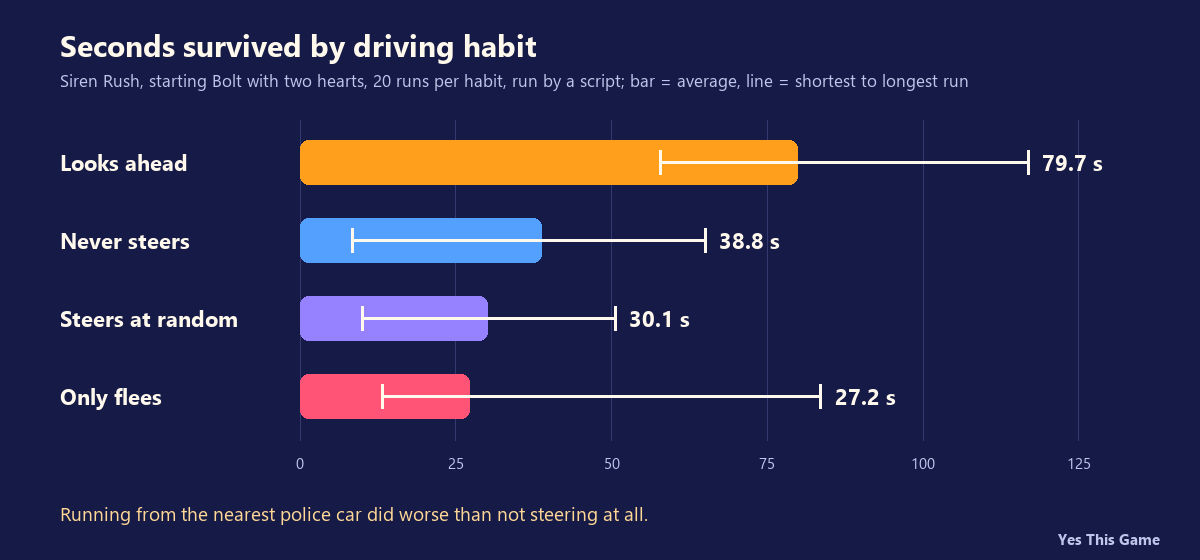
The first police chase game tip is to plan one second ahead instead of just running: in Siren Rush, a script that looked ahead for gaps lasted 79.7 seconds on average, while a script that never steered lasted 38.8, one that steered at random 30.1 and one that only fled from the nearest police car 27.2. The rest of this guide shows what else the numbers say about crashes, cars and hearts.
How Siren Rush works
Siren Rush is our own top-down police chase game. Your car drives by itself at full speed and you only steer left and right. The police come from every side. Most of them are quicker than your first car on a straight road, but they turn wide, so a sharp turn makes them skid into each other, into rocks and into red barrels. Each police car has a health bar and blows up when it runs out; your own car survives a set number of hits, shown as hearts, and every police touch takes one. You earn a star for every 25 seconds you last, and each star calls a tougher kind of police car. The score is the number of seconds you survive.
What we measured
We wrote four drivers, one for each habit a player might fall into, and ran each of them through the game’s own logic without drawing the picture:
- Looks ahead. Every fifth of a second it tries a left turn, a right turn and straight on, follows each for 0.9 seconds and picks the one that keeps the widest gap to police cars and rocks. It uses the car’s ability when a police car comes within 8 meters.
- Never steers. Drives straight ahead for the whole run.
- Steers at random. Presses left, right or nothing for random spans between 0.15 and 0.85 seconds and uses the ability now and then.
- Only flees. Every quarter of a second it turns away from the nearest police cars and toward the nearest banknote, and uses the ability when a car is close.
The runs use fixed seeds, and even the random driver draws its choices from a seeded generator, so the same command gives the same numbers. A run ends when the car is wrecked or after 300 seconds. We flew 232 runs: 20 per habit with the starting Bolt (two hearts), 8 per car with the looks-ahead driver, and 12 for each heart count and driver. No person drove these runs, so the numbers show what each habit does, not what a skilled player can reach.
| Habit | Average (s) | Median (s) | Shortest to longest (s) | Police destroyed per run | Longest chain per run | Rampages per run |
|---|---|---|---|---|---|---|
| Looks ahead | 79.7 | 75.0 | 57.9 to 116.9 | 21.6 | 6.3 | 2.4 |
| Never steers | 38.8 | 37.1 | 8.4 to 65.0 | 3.0 | 1.9 | 0.1 |
| Steers at random | 30.1 | 33.0 | 10.0 to 50.6 | 5.2 | 2.7 | 0.4 |
| Only flees | 27.2 | 19.6 | 13.3 to 83.6 | 4.2 | 2.0 | 0.3 |
Plan ahead, do not just run
The looks-ahead driver lasted twice as long as any other habit and destroyed 21.6 police cars per run, against 3 to 5 for the rest. The surprise is the bottom of the table: steering away from the nearest police car did worse than not steering at all. Police come from every side, so dodging one car tends to put you in front of the next, and a stream of small turns also wastes the car’s speed. The driver that scored best never asked “which car is closest?” but “which way leaves the most room one second from now?”. That is a habit you can copy by eye: look at where the cars will be, not where they are.
Let the police crash into each other
In the looks-ahead and only-flees runs together, 517 police cars were destroyed. We counted what finished each one:
| What finished the police car | Cars | Share |
|---|---|---|
| Crashing into another police car | 179 | 34.6% |
| The blast of another police car | 156 | 30.2% |
| The player’s car ramming it | 67 | 13.0% |
| A rock | 53 | 10.3% |
| A red barrel | 52 | 10.1% |
| A bomb pickup | 10 | 1.9% |
Two out of three police cars (335 of 517) died because of other police cars, in a crash or in a blast that spread. Only one in eight died under your bumper. That is why the best habit is to steer so that the police meet each other, and why a sharp turn through a pack beats a head-on ram. Chains matter too: the looks-ahead driver set off a chain of 6.3 police cars at its best moment of an average run, and the straight driver only 1.9.
Speed before armor
We gave the looks-ahead driver each of the ten cars in turn, eight runs each:
| Car | Price | Hearts | Average (s) | Runs that reached 300 s |
|---|---|---|---|---|
| Bolt | Starting car | 2 | 83.7 | 0 of 8 |
| Cab 77 | $300 | 2 | 88.6 | 0 of 8 |
| Brawler | $800 | 3 | 198.7 | 0 of 8 |
| Haulback | $1,500 | 3 | 115.0 | 0 of 8 |
| Fog Van | $2,500 | 4 | 133.9 | 0 of 8 |
| Volt EV | $4,000 | 2 | 175.4 | 0 of 8 |
| Dirtline | $6,000 | 3 | 255.8 | 2 of 8 |
| Vanta GT | $8,500 | 2 | 289.8 | 7 of 8 |
| Stomper | $12,000 | 5 | 194.6 | 1 of 8 |
| Mirage | $16,000 | 3 | 274.1 | 5 of 8 |
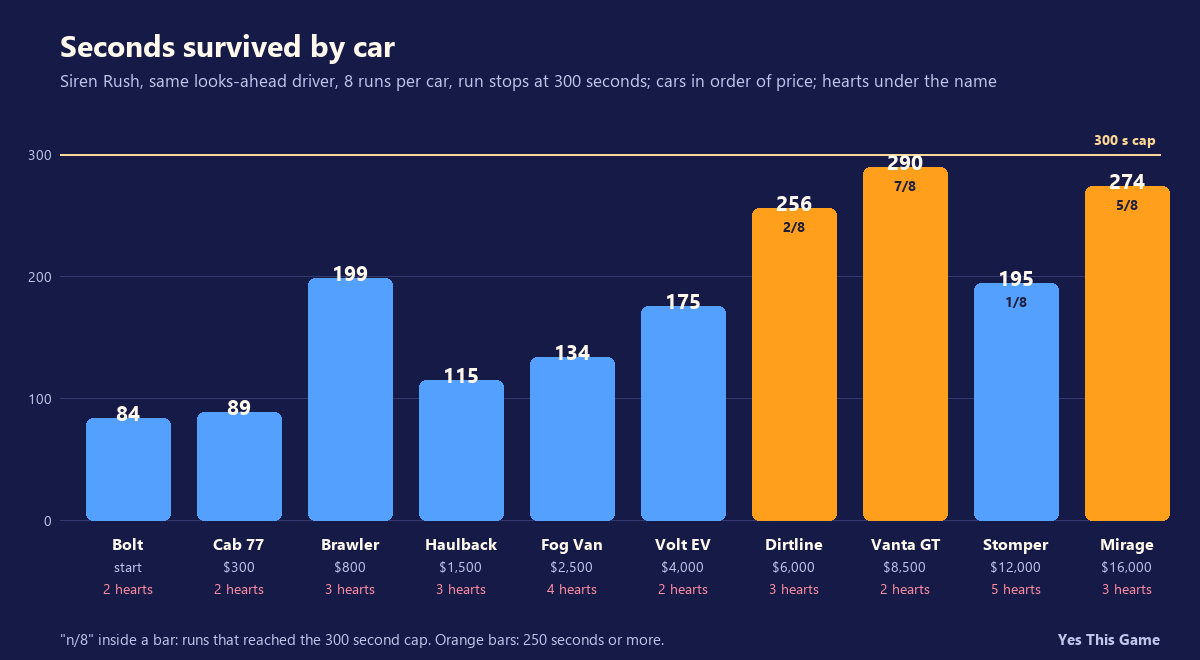
The fast cars won. The 2-heart Vanta GT lasted almost 290 seconds and the 3-heart Mirage 274, while the 5-heart Stomper, the tankiest car, lasted 195 and the 4-heart Fog Van 134. A fast car finishes turns before the police can close, so it takes fewer hits to begin with. The Brawler is the value pick: at $800 it lasted 199 seconds, close to the Stomper at fifteen times the price, and the script destroyed 99 police cars per run with it. Note that these runs include each car’s ability, which the script fires whenever a police car comes within 8 meters.
Hearts: about 17 seconds each
Health is the one upgrade that adds a whole extra hit. We took the starting Bolt from two hearts to four and six and ran 12 runs each:
| Hearts | Looks ahead (s) | Steers at random (s) |
|---|---|---|
| 2 | 79.1 | 27.6 |
| 4 | 113.7 | 43.9 |
| 6 | 147.9 | 58.3 |
Each extra heart added about 17 seconds to the looks-ahead driver and about 8 seconds to the random one. The gain was bigger for the careful driver, probably because a heart is worth more to someone who does not waste it. A wrench pickup gives one heart back, so grabbing it on your last heart is worth about one level of the health upgrade.
Fill the flame bar
Destroyed police cars, near misses and banknotes all fill the flame bar, and a full bar starts Rampage: six seconds in which the police run from you, everything you touch is wrecked and nothing can hurt you. The looks-ahead driver triggered Rampage 2.4 times per run, about 14 of its 80 seconds. The straight driver triggered it once in ten runs. Rampage is the reward for the habits above, not a separate plan: crash the police and the bar fills by itself.
5 tips that follow from the numbers
- Look a second ahead. It doubled survival time against every other habit.
- Do not flee the nearest car. That habit did worse than driving straight.
- Let the police meet each other. Two out of three destroyed police cars died because of other police cars.
- Buy speed first. The fast Vanta GT beat the tough Stomper by almost 100 seconds, and the Brawler is the cheap way in.
- Spend early cash on health. Each heart was worth about 17 seconds.
Where to try it
Drive it yourself in Siren Rush. For two more of our own driving games, Mesadash steers a muscle car across the desert past rocks and cacti, and Car Drift Racer 2024 is a 3D drift game with a career on three tracks. If you want another police chase on the site, try Escape the Police.
Frequently asked questions
How do you survive longest in a police chase game?
Plan a second ahead and steer toward the biggest gap. In Siren Rush a script that did this lasted 79.7 seconds on average, against 38.8 seconds for a script that never steered.
Is running away from the nearest police car a good plan?
No. The script that only fled from the nearest police car lasted 27.2 seconds, less than one that drove straight. Fleeing one car often turns you into the path of the next.
Which car lasted longest in your test?
The Vanta GT, a 2-heart supercar, lasted 289.8 seconds on average and reached the 300 second cap in seven of eight runs. The 5-heart Stomper averaged 194.6.
Do hearts or speed matter more?
Both help, but speed helped more per car. Hearts added about 17 seconds each for the planning script when we upgraded the starting Bolt from two to six.
Who destroys the police cars?
Mostly other police cars. Of 517 police cars destroyed in two habits, 35% died in crashes with each other, 30% in the blast of another police car and only 13% in the player’s own rams.
Did a person drive these runs?
No. A script drove the game’s own logic, without drawing the picture, 232 times with fixed seeds. It shows what each habit does, not what a skilled person can reach.