Puzzle guide
Tic Tac Toe Tips: Sixty Games Against Three Levels
Key takeaways
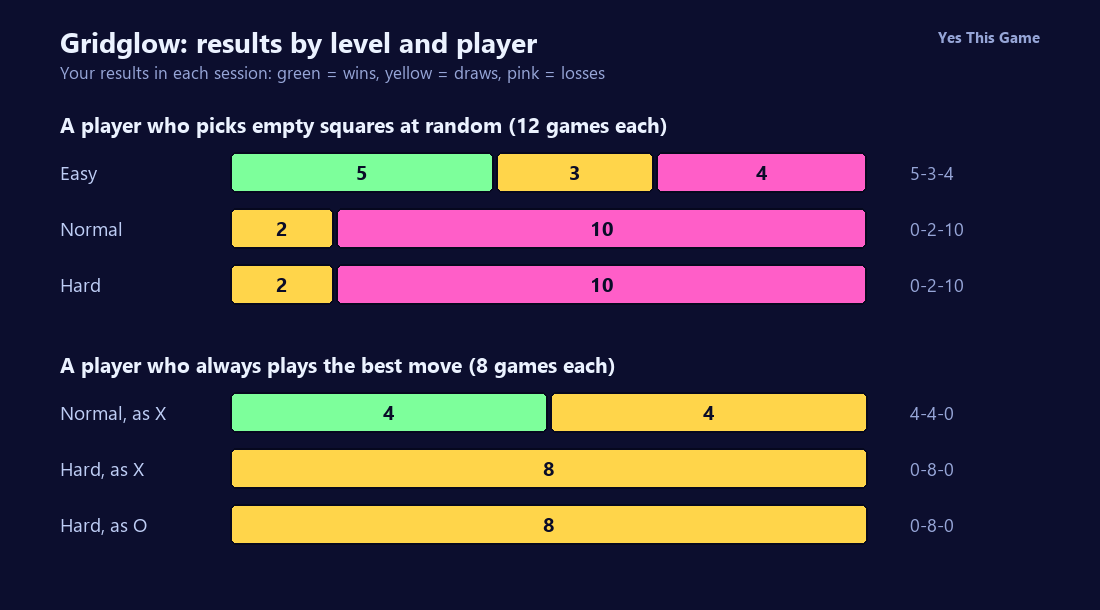
- A player who picked empty squares at random won 5 of 12 on Easy but only 0 of 12 on Normal and on Hard.
- Playing the best move every time drew all 16 games against Hard, as X and as O.
- The same best play won 4 and drew 4 of 8 games against Normal.
- The computer answers after about half a second, so games move fast.
The first tic tac toe tip is to treat Hard as a draw, not a win: in Gridglow we played the best move every time and drew all 16 games against it. Normal was beatable, and random moves lost most games on both Normal and Hard.
How the game works
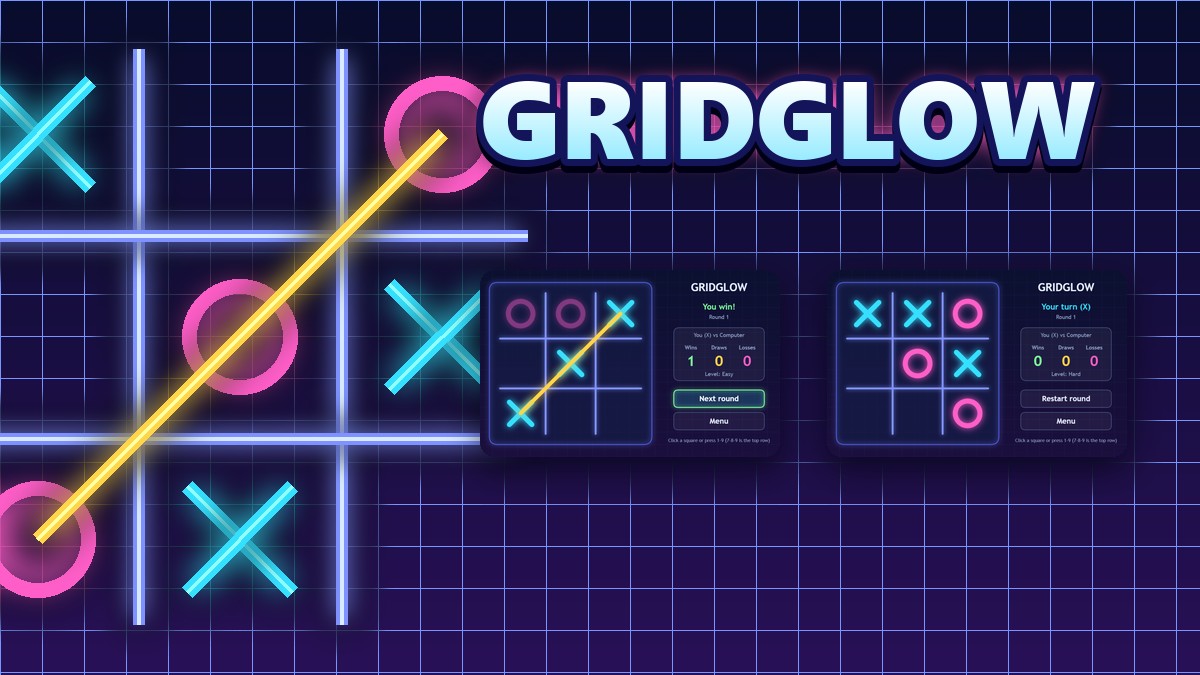
Gridglow is a neon noughts and crosses game. On the start screen you choose Computer or Friend, a level of Easy, Normal or Hard, and whether you play X (first) or O (second). The game screen shows a glowing 3 by 3 grid, a status line, a round counter and a tally of wins, draws and losses. Three in a row ends the round and a gold line runs through the winning squares. The computer answers after about half a second.
What we measured
We played in a test browser at 1280 by 800 pixels, with a script that clicked the squares and read the result of each game. We ran two kinds of player. The first picked an empty square at random each turn, for 12 games at each level. The second always played the best move, found by searching every possible continuation, for 8 games each against Normal as X, Hard as X and Hard as O.
| Player | Level | Games | Wins | Draws | Losses |
|---|---|---|---|---|---|
| Random moves | Easy | 12 | 5 | 3 | 4 |
| Random moves | Normal | 12 | 0 | 2 | 10 |
| Random moves | Hard | 12 | 0 | 2 | 10 |
| Best moves, as X | Normal | 8 | 4 | 4 | 0 |
| Best moves, as X | Hard | 8 | 0 | 8 | 0 |
| Best moves, as O | Hard | 8 | 0 | 8 | 0 |
Small samples from one test browser, so the counts are rough. The random player’s results depend on luck and would shift in another run. Gridglow is our own game, so we also know how the levels work: Easy picks any empty square, Normal finishes a line or blocks yours when it can and otherwise picks at random, and Hard looks at every continuation.
What each level feels like
Easy gave the random player five wins in twelve games, so it makes plenty of mistakes. Normal and Hard looked the same to the random player, with ten losses each, because both finish a line or block yours when they can. The difference showed up with best play: it won half of the Normal games and none of the Hard ones.
4 tips that follow from the numbers
- Aim for a draw on Hard. Sixteen of sixteen best-play games ended that way.
- Practice on Normal. Best play won four of eight games there.
- Do not play at random. It lost ten of twelve on Normal and on Hard.
- Try O on Hard. The computer moves first, which makes it a good test of defense.
Where to try it
Try it yourself in Gridglow. For a bigger board game, Queenrook is a two player 3D chess game, and Pixelcoil is a pixel snake game.
Frequently asked questions
Can you beat Hard in Gridglow?
Not in our tests: best play drew all 16 games against it.
Is Normal beatable?
Yes. Best play won 4 of 8 games against Normal.
How did random moves do?
5 wins in 12 on Easy, none in 12 on Normal and none in 12 on Hard.
Does it matter if you play X or O?
Against Hard, best play drew all 8 games either way.
Who moves first?
X always moves first; choose O to let the computer start.
Can two people play?
Yes, Friend mode shares one screen.