Puzzle guide
Water Sort Puzzle Tips and Tricks: How to Solve Any Level
Key takeaways
- Pouring into your last empty tube led to a dead end 28% of the time. With a second tube still empty, the same kind of pour failed 1.5% of the time.
- Completing a tube (1,474 pours) or emptying one (1,369 pours) never made a level unsolvable.
- Dead ends come early. In the last third of a level only 3.5% of pours are wrong.
- One extra tube lifted random play from 2% to 55% solved on 12-color levels.
The quickest way to get better at water sort puzzles is to protect your last empty tube. Pour into it only when the move uncovers a color you can use at once, finish a color whenever you can, and treat the first two thirds of a level as the risky part. We tested these rules on 19,631 pours in our own Water Sort Puzzle, and the numbers below show how much each one matters.
How a water sort puzzle works
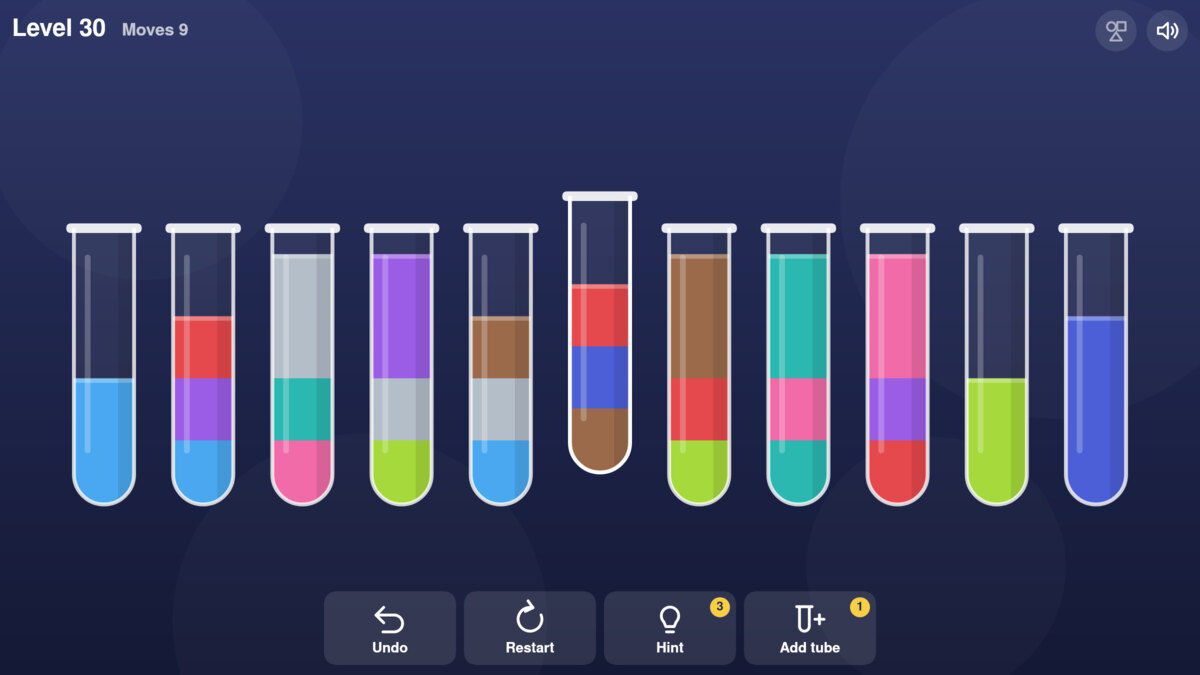
A water sort puzzle is a color sorting game. Glass tubes hold layers of colored water in mixed order, and you pour from tube to tube until every tube holds a single color.
- Each tube holds four layers.
- You can pour only onto the same color or into an empty tube, and only while the target tube has room.
- Layers of one color that sit together move together. If the target has less room than the block, only part of the block moves.
- The classic layout has two empty tubes. A level with seven colors has nine tubes.
- The level is solved when every tube is either empty or full of one color.
That is the whole rulebook, and it is enough to make a hard problem. In 2022 a group of researchers proved that deciding whether a water sort position can be solved at all is NP-complete. In plain words: nobody knows a shortcut that works on every position. Good habits are what get you through.
What 19,631 pours showed us
We wrote the game, its level generator and its solver, so we can test advice instead of repeating it. We followed the solver through levels 1 to 100. At each of the 3,852 positions on the way we tried every legal pour and then searched every continuation to see whether the level could still be solved.
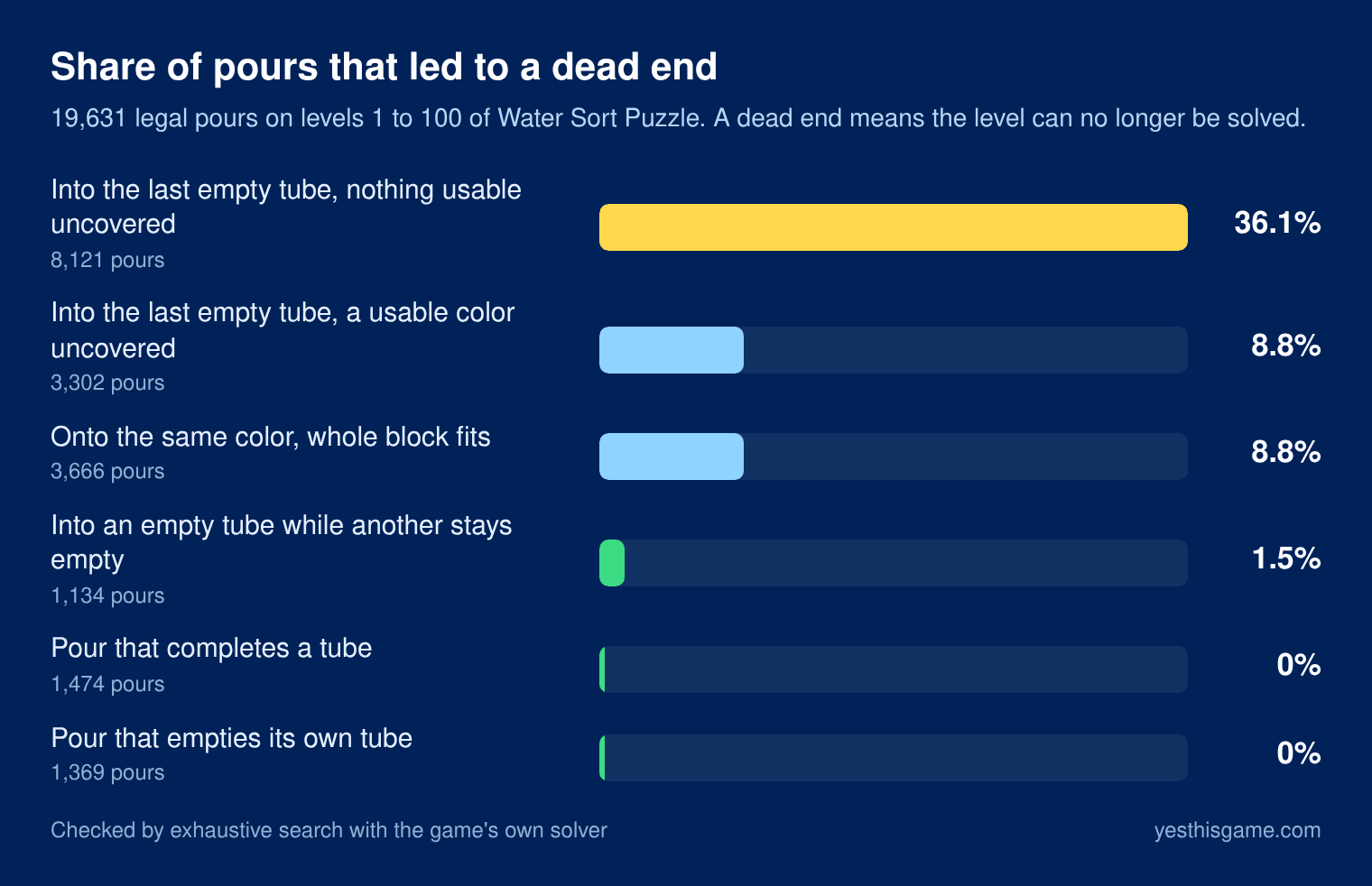
Of the 19,631 pours, 3,557 (18.1%) were dead ends: after them the level could not be solved without undo. The risk depends heavily on the kind of pour.
| Kind of pour | Pours checked | Dead ends |
|---|---|---|
| Into the last empty tube, nothing usable uncovered | 8,121 | 36.1% |
| Into the last empty tube, a usable color uncovered | 3,302 | 8.8% |
| Onto the same color, whole block fits | 3,666 | 8.8% |
| Into an empty tube while another tube stays empty | 1,134 | 1.5% |
| Pour that completes a tube | 1,474 | 0% |
| Pour that empties its own tube | 1,369 | 0% |
| All pours | 19,631 | 18.1% |
“Usable” means the color you uncover can go straight onto the same color in another tube. The rows overlap and do not add up to the total.
Three more findings shape the tips below:
- In 71% of the positions every legal pour was safe. In 10% exactly one pour was safe. A level is mostly easy, with a few moments that decide it.
- Those moments come early. In the first third of a solution 21.3% of the possible pours were dead ends, in the middle third 23.6%, in the last third 3.5%.
- 91 of the 100 levels had at least one dead end waiting somewhere along the way.
9 water sort tips that hold up
1. Guard your last empty tube
This is the rule that matters most. Pouring into an empty tube while a second tube was still empty went wrong 1.5% of the time. Pouring into the last empty tube went wrong 28.2% of the time. As long as one tube is empty you can almost always repair a mistake. Once both are in use, you are relying on being right.
2. Look at what a pour uncovers
Before you use your last empty tube, look at the color underneath the one you are about to move. If it can go straight onto the same color in another tube, the pour was a dead end 8.8% of the time. If it uncovered nothing you could use, the figure was 36.1%. Same tube, same move, four times the risk.
3. Finish a color whenever you can
We checked 1,474 pours that completed a tube. None of them caused a dead end. A finished tube never gets in your way again, so when you can complete a color, do it.
4. Empty a tube whenever you can
The same holds for pours that empty their own tube: 1,369 checked, no dead ends. Each one hands you a new empty tube, and empty tubes are what the whole puzzle runs on.
5. A matching pour is a good sign, not a guarantee
Pouring a whole block onto its own color feels automatically right. In our data about one in eleven of those pours (8.8%) still ended in a dead end. When two matching pours are possible, prefer the one that completes or empties a tube.
6. Read the bottom layers first
The color at the bottom of a tube cannot move until everything above it has moved. Before your first pour, look along the bottom row. A color with two layers at the bottom of the same tube will probably end up there. A color whose four layers all sit under other colors will be the last one you solve.
7. Think hard early, relax late
Dead ends cluster in the first two thirds of a level. That is where it pays to stop and compare two pours. Near the end only 3.5% of pours are wrong, so you can play quickly once most colors are in place.
8. An empty tube you never use is worth nothing
Guarding a tube does not mean hoarding it. We ran a bot that refused to pour into an empty tube as long as any same-color pour existed. On 5-color levels it solved 13% of its attempts within 200 pours. Pouring completely at random solved 79%. The careful bot mostly went around in circles, moving the same colors back and forth. Use the first empty tube freely, and spend the last one when it buys you something.
9. Use undo, hints and the extra tube on purpose
Undo is unlimited, so use it to test an idea and step back. Each level also gives you three hints and one extra tube. The extra tube is the strongest help by far. Random pouring solved 12-color levels 2% of the time with two empty tubes and 55% of the time with three. Over all 100 levels the solve rate went from 19% to 74%.
How to solve any level, step by step
- Scan the bottoms. Note which colors are buried and which already have two layers together.
- Take the free moves. Any pour that completes a tube or empties a tube is safe. Make them first, every time they appear.
- Open the first empty tube. Choose the pour that uncovers a color you can place straight away.
- Chain the result. Every uncovered color that has a matching home should go there before you touch the second empty tube.
- Stop before the last empty tube. Ask one question: after this pour, can the color underneath move somewhere? If not, look for another pour.
- If nothing moves, step back. Undo to the last position where a tube was empty and take the other option. If you have gone too far, restart or add the extra tube.
Try it now: play Water Sort Puzzle in your browser. There is nothing to download and every level can be solved.
How hard do the levels get?
More colors mean longer solutions and less room for error. This is how the first 100 levels of our game behave. “Random pouring” picks any legal pour by chance, up to 200 pours per attempt.
| Colors | Tubes | Levels | Pours in our solver’s solution | Solved by random pouring | With the extra tube |
|---|---|---|---|---|---|
| 3 | 5 | 1 | 6 | 100% | 100% |
| 4 | 6 | 2 to 3 | 13 to 17 | 95% | 100% |
| 5 | 7 | 4 to 6 | 17 to 22 | 79% | 100% |
| 6 | 8 | 7 to 10 | 19 to 29 | 65% | 100% |
| 7 | 9 | 11 to 16 | 25 to 28 | 47% | 99% |
| 8 | 10 | 17 to 24 | 25 to 33 | 35% | 95% |
| 9 | 11 | 25 to 34 | 33 to 44 | 21% | 90% |
| 10 | 12 | 35 to 48 | 32 to 43 | 8% | 80% |
| 11 | 13 | 49 to 64 | 37 to 49 | 12% | 67% |
| 12 | 14 | 65 and up | 40 to 59 | 2% | 55% |
The first pour is rarely the problem. Up to 10 colors not a single opening pour made a level unsolvable, and at 11 and 12 colors about 2% did. Levels are lost in the middle, when the last empty tube gets used for the wrong color.
How we measured
All numbers come from the code of the Water Sort Puzzle on this site: four layers per tube, two empty tubes, levels 1 to 100 exactly as players get them. For every position on the solver’s path we tried each legal pour and ran an exhaustive search to decide whether a solution still existed. The random player made 300 attempts per level.
Other water sort games with the same rules behave the same way. Games with larger tubes, hidden layers or locked tubes will give different percentages, but the order of the tips should not change.
If you enjoy planning a few moves ahead, the same habit pays off in sliding block puzzles and in Seat Jam. All our puzzle games are free to play in the browser.
Frequently asked questions
Is every water sort level solvable?
In our Water Sort Puzzle, yes. The generator keeps a level only after the solver has finished it. In other apps it depends on the game. A level can still become unsolvable after a wrong pour, which is what undo is for.
What should I do when I am stuck in water sort?
Undo back to the last position where a tube was still empty and try the other pour. If that is too far back, restart the level or add the extra tube. In our game the hint tells you when a position has no solution left.
How many moves does a water sort level take?
It grows with the number of colors. In our game the solver needs 6 pours for the first level with 3 colors, about 25 to 33 pours at 8 colors and 40 to 59 pours at 12 colors.
Is there a water sort puzzle solver?
Our game has one built in. The Hint button runs a solver on your current position and shows a pour that keeps the level solvable. You get three hints per level.
What is the best first move in water sort?
Almost any. Up to 10 colors, none of the opening pours we tested made a level unsolvable. Start with a pour that joins two blocks of the same color, and save your thinking for the moment your last empty tube is at stake.
Can I play water sort without downloading an app?
Yes. Water Sort Puzzle on Yes This Game runs in the browser on phones, tablets, computers and Chromebooks. There is no download and no sign-up.